


NEWS
Career 2.0: From IR Manager to Senior IR Leadership, Business Leadership and Beyond – and the Power of Personal Branding
How do you take greater ownership of your career in investor relations? How do you progress from being an excellent IR practitioner to becoming a more senior, strategic and influential leader? How will AI change the skills required of the next generation of IROs? And how important is personal branding in ensuring that your capabilities, contribution and potential are recognised?
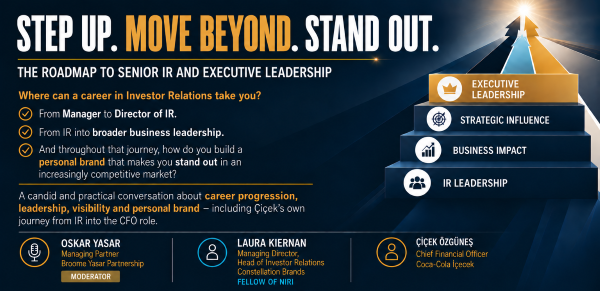
These were among the central themes of a recent lively and highly practical Career 2.0 discussion hosted by TUYID, bringing together Laura Kiernan, Çiçek Özgüneş and Oskar Yasar to explore the changing career opportunities available to today’s investor relations professionals.
A major theme was the evolution of the IRO from communicator and market interface to strategic adviser and corporate influencer. The strongest IR leaders increasingly sit at the intersection of the company, its management and the capital markets, bringing an external perspective into the organisation and helping senior management understand not simply what investors are saying, but what that means for strategy, valuation, capital allocation and corporate decision-making.
The discussion also explored what it takes to make the transition from IR manager to senior IR leader: developing greater commercial understanding, building credibility with the CEO, CFO and Board, learning to challenge constructively, managing and developing teams, and becoming confident enough to bring independent judgement into senior-level conversations.
Importantly, there is no single career destination. For many IROs, the ambition is to become a leading Head or Director of Investor Relations and continue building influence within the function. For others, the experience gained through IR can create opportunities across strategy, finance, communications and broader business leadership. The key is understanding the different pathways available and consciously building the experience and skills required for whichever direction is right for the individual.
Another important discussion centred on demonstrating the strategic value of IR internally. Rather than simply reporting activity, leading IR functions can establish longer-term plans with clear objectives and KPIs, measuring progress against areas such as investor targeting, market understanding, valuation, perception and the development of the equity story. This not only provides greater discipline to the IR programme but helps management understand what excellent IR can realistically achieve.
AI was another significant part of the conversation. As technology increasingly takes on elements of data gathering, analysis, monitoring, targeting and routine communications, the discussion focused on what this means for the human skills that will differentiate the next generation of IR leaders. AI should enable IROs to spend less time on process and more time on interpretation, judgement, relationships and strategic counsel. Rather than diminishing the role, used effectively it has the potential to elevate it, but it will also require IR professionals to continually adapt their skills and understand how technology can make them more effective.
And alongside these changes sits another increasingly important component of career development: personal branding.
Being exceptionally good at your job is essential, but it does not automatically mean that your capabilities or potential are recognised. The discussion explored why ambitious IROs should think deliberately about what they are known for, how they are perceived and whether their professional reputation accurately reflects the value they bring.
Personal branding is not simply about self-promotion or social media. It is about developing professional credibility and visibility, contributing to the profession, building a meaningful network, sharing expertise and becoming associated with particular areas of knowledge or leadership. Just as importantly, it is about building an internal personal brand, ensuring that management and colleagues recognise both the strategic contribution of IR and the individual behind it.
The message running throughout the discussion was that career progression, leadership development, technological change and personal branding increasingly need to be considered together. Technical excellence remains fundamental, but the future IR leader will also need commercial understanding, strategic influence, leadership capability, technological fluency, professional visibility and a strong reputation.
For ambitious IROs, Career 2.0 is ultimately about taking ownership of what comes next. Whether the ambition is to lead a major IR function, broaden the role, move into another corporate discipline or ultimately take on wider business leadership, there are now more pathways open to IR professionals than perhaps at any point in the profession’s development.